


Nitrat kommt natürlich in Böden, Pflanzen und Wasser vor. Erhöhte Konzentrationen können jedoch insbesondere im Grundwasser auftreten. Erfahren Sie, wie der Nitratgrenzwert in Deutschland geregelt ...
Panier
(0 article)
Votre panier est vide
Nitrate is a naturally occurring form of nitrogen found in soil, food and water. Small amounts in drinking water are not unusual, but higher concentrations can occur when nitrate from fertilisers, manure, wastewater or other sources reaches groundwater or surface water. Whether nitrate is relevant to your household depends on your water source and, most importantly, the result of a reliable water test. If nitrate is elevated, treatment methods such as nitrate-selective ion exchange or reverse osmosis can reduce it.
Yes, but not every type of water filter removes nitrate.
Nitrate is dissolved in water, so a basic filter designed to catch particles is not enough. Treatment methods such as nitrate-selective ion exchange, reverse osmosis and electrodialysis can reduce nitrate. Conventional activated carbon and ordinary particle filters generally cannot. UK guidance on nitrate treatment
| Filtration method | Can reduce nitrate? | How it works |
|---|---|---|
| Nitrate-selective ion exchange | Yes | Uses a specialised resin to capture nitrate |
| Reverse osmosis | Yes | Uses a membrane to separate many dissolved substances from water |
| Electrodialysis | Yes | Uses membranes and an electrical field to separate dissolved ions |
| Activated carbon | Generally no | Designed for other substances, rather than dissolved nitrate |
| Particle filtration | No | Removes particles rather than dissolved substances |
| UV treatment | No | Helps inactivate microorganisms but does not remove nitrate |
The important thing is to look for evidence that the specific system reduces nitrate, rather than assuming that a filter will remove nitrate because it removes other contaminants.
Nitrate is a naturally occurring compound made from nitrogen and oxygen. Its chemical formula is NO₃⁻.
Nitrogen is an essential part of the natural environment. Plants need it to grow, and nitrate is one of the forms in which nitrogen moves through soil and water.
Finding nitrate in water does not automatically mean that something has gone wrong. How much nitrate is present and where it came from are what matter.
Nitrate can enter water naturally, but human activities can increase the amount that reaches groundwater and surface water. Agriculture is an important example, particularly where nitrogen fertilisers or animal manure are used. UK guidance on nitrate in drinking water
Drinking-water standards set limits for nitrate because the concentration matters.
For example, in England and Wales, the drinking-water standard is 50 mg of nitrate (NO₃) per litre of water at the consumer's tap. Nitrite has a separate standard. UK drinking-water standards
Other countries use their own regulations and monitoring systems, so always check the standard that applies where you live.
A regulatory limit does not mean that water containing any measurable amount of nitrate is automatically unsafe. Public drinking-water supplies are routinely monitored and managed to meet the standards that apply to them.
For an individual household, the more useful questions are:
Nitrate can reach water through natural processes, but certain human activities can increase concentrations.
Agriculture is one of the most important sources of nitrate entering groundwater and surface water.
Plants need nitrogen, so farmers use nitrogen fertilisers and animal manure to support crop growth. When more nitrogen is present than plants can use, some can remain in the soil and eventually move into water.
Rain can carry nitrate through the soil towards groundwater or into rivers and other surface waters. Nitrate can be particularly persistent once it reaches groundwater. UK drinking-water data on nitrate sources
Wastewater can also contribute nitrogen to the environment.
Public wastewater treatment systems are designed to manage wastewater before it is released back into the environment, but wastewater remains one possible source of nitrogen entering water. UK guidance on nitrate sources and treatment
Nitrate is also part of the natural nitrogen cycle.
Soil microorganisms naturally convert different forms of nitrogen into nitrate, which plants can then use.
This is why the presence of nitrate alone does not tell you whether water has been affected by pollution. Concentration and source matter.
No, not necessarily.
This distinction is particularly important when talking about drinking water.
Groundwater is water beneath the ground. It may be used as a source of drinking water, particularly by households with private wells.
Tap water is the water that reaches your household through a water supply system. It may come from groundwater, rivers, reservoirs or other sources, and it may be treated before it reaches the tap.
That means a nitrate concentration measured in groundwater does not automatically tell you the nitrate concentration in someone's tap water.
Public water suppliers routinely monitor drinking water and manage the supply to meet the standards that apply to it. Current UK information shows that nitrate is routinely tested at consumers' taps, with treatment and other controls used where necessary to maintain compliance. Current UK information on nitrate in drinking water
Private wells are different because the household may be responsible for understanding and testing its own water source.
If you rely on a private well, testing can tell you whether nitrate is present and at what concentration. Specific guidance is available for private water supplies that do not comply with the nitrate standard. Guidance on nitrate and private water supplies
Nitrate and nitrite are related, but they are different substances.
They have different chemical structures and are subject to separate drinking-water standards. In England and Wales, the standard at consumers' taps is 50 mg/L for nitrate and 0.5 mg/L for nitrite. UK drinking-water standards
This distinction matters when you read a water-quality report. A nitrate result is not automatically a nitrite result.
You may also see:
These are different ways of expressing the concentration, so they should not be compared directly without checking the units and reporting basis.
If you are comparing a test result with a drinking-water limit, make sure you are comparing like with like.
Nitrate is dissolved in water, so it needs a treatment method that can deal with dissolved substances.
The main technologies used to reduce nitrate include:
They work in different ways, and the right choice depends on factors such as nitrate concentration, water use, the characteristics of the water and the maintenance involved. UK guidance on nitrate treatment
Ion exchange uses a material called a resin.
In simple terms, the resin captures nitrate from the water as the water passes through it. The nitrate takes the place of other ions held by the resin.

The resin has a limited capacity, so that capacity is gradually used up as more water passes through. Eventually, nitrate can begin to pass through the treatment material again. This is known as breakthrough.
Performance can be affected by:
Some nitrate-selective resins can be regenerated when their capacity is exhausted. Technical guidance on ion exchange The US Environmental Protection Agency also notes that treatment capacity varies according to the resin and the characteristics of the incoming water. EPA guidance on anion exchange
The practical question is therefore not simply “Does ion exchange remove nitrate?”
It is:
How well does this particular system remove nitrate, and for how long?
Yes. Reverse osmosis (RO) can reduce nitrate.
An RO system uses pressure to push water through a special membrane. The membrane allows water to pass while retaining many dissolved substances.

The substances retained by the membrane are carried away in a separate concentrate or reject stream. EPA guidance on reverse osmosis
RO can therefore be useful when nitrate reduction is one of several water-treatment goals.
However, RO systems also have practical considerations, including:
As with ion exchange, the important thing is to look at the actual performance of the specific system, rather than assuming that every RO system performs in exactly the same way.
Generally, no.
Activated carbon can be useful for reducing certain substances, including some compounds that affect taste and odour. But conventional activated carbon is not designed to remove dissolved nitrate effectively.
The US Environmental Protection Agency's guide to household water-treatment systems lists activated carbon as a technology that does not remove nitrates, while some reverse-osmosis systems can reduce them. EPA guide to household water-treatment systems
This is easy to overlook because many household water filters contain activated carbon.
A filter can be effective at reducing one type of contaminant while having little effect on another. If nitrate reduction is your goal, look for specific evidence that the filter reduces nitrate.
A water test is a useful starting point if you want to know whether nitrate is actually an issue for your household.
But a test result needs a little context.
First, look at the number.
A nitrate result might be reported in mg/L. You can then compare it with the relevant drinking-water standard for your location.
Make sure the result is actually for nitrate, rather than nitrite or nitrate-nitrogen.
This is particularly important if you are comparing results from different laboratories or with information published by a government authority.
Was the sample taken from:
The answer affects what the result tells you.
Water quality can change over time, particularly in private water supplies and environmental water sources.
The date of the test therefore matters.
A single test gives you a snapshot.
If the water source is variable, repeat testing may sometimes help establish whether a result is typical or unusual.
A nitrate-specific filter may make sense when testing shows that nitrate is elevated and you specifically want to reduce it.
This can be particularly relevant for households using:
For a household whose public water supply is routinely monitored and meets the applicable drinking-water standards, there may be no particular reason to install a nitrate filter.
The important thing is to base that decision on your water and your circumstances, rather than on the presence of nitrate in the environment alone.
Once you know that nitrate reduction is relevant, don't choose a system based only on the words “nitrate filter” on the packaging.
Look for clear evidence about what the system actually does.
Look for measured results showing the nitrate concentration before and after treatment.
A statement such as “reduces nitrate” is useful, but it is much more informative when you can see the actual test conditions and results behind the claim.
A filter's capacity matters alongside its initial reduction performance.
If a system can reduce nitrate effectively but only for a small volume of water, that can make a significant difference to its practical usefulness and cost.
Good performance information should explain enough about the test for you to understand what the result means.
For example:
The more transparent the information, the easier it is to make a meaningful comparison.
This is especially important for technologies such as ion exchange.
Does the treatment material need to be replaced? Can it be regenerated? How often does this need to happen?
These details affect both ongoing cost and maintenance.
Nitrate may be only one of your reasons for considering filtration.
You might also care about taste, odour, chlorine, hardness, microorganisms or other substances.
Different technologies address different water-quality concerns, so it is worth looking at the whole picture rather than choosing a system based on one headline claim.
No.
The presence of nitrate in the environment does not mean that every household needs a nitrate filter.
Public drinking-water supplies are routinely monitored and managed to meet the standards that apply to them. In England, for example, 24,518 nitrate tests were reported in 2025, with two reported exceedances. UK drinking-water data for 2025
Private wells and other private water supplies may need more direct attention because the household may be responsible for testing its own source. Guidance on nitrate and private water supplies
If testing shows that nitrate reduction is appropriate, you can compare treatment options based on their verified performance, capacity, maintenance and suitability for your water.
Nitrate can occur naturally in water, and the important consideration is the concentration. Drinking-water standards set limits for nitrate, while public water supplies are routinely monitored and managed to meet those standards. Private water supplies may require more direct testing.
Boiling is not a reliable method for removing nitrate. If nitrate reduction is needed, use a treatment method specifically designed and tested for nitrate removal.
Not necessarily. Many household filters are designed to reduce particles, chlorine, taste or odour rather than dissolved nitrate. Check whether the specific filter has verified nitrate-reduction performance.
Conventional activated carbon generally does not remove dissolved nitrate effectively. Nitrate requires a treatment technology specifically capable of reducing it. EPA guide to household water-treatment systems
There is no single best method for every situation. Nitrate-selective ion exchange, reverse osmosis and electrodialysis can all be used to reduce nitrate. The right choice depends on the water, the amount of treatment needed, maintenance requirements and the verified performance of the specific system.
If you use a public water supply, information about water quality may be available from your water supplier or relevant authority. If you use a private well or another private water source, direct testing can be particularly useful because the quality of the source can vary.
For public supplies in England and Wales, you can also ask your water company for a water-quality report showing nitrate information for your local supply zone. UK guidance on nitrate in drinking water
Nitrate is a natural part of the nitrogen cycle, but higher levels can enter water through sources such as agriculture and wastewater.
What matters is how much nitrate is present, where your water comes from and which standard applies to it.
Public drinking-water supplies are routinely monitored and managed to meet applicable standards. Private wells and other private water supplies may need more direct attention through household testing.
If you want to understand what's in your drinking water, testing is a good place to start. If nitrate levels are elevated, there are treatment options that can help reduce them.
The right choice depends on your water and on the performance, capacity and maintenance of the system you're considering.
Once you understand your water, you can make a more informed choice about what comes next.
Nitrat kommt natürlich in Böden, Pflanzen und Wasser vor. Erhöhte Konzentrationen können jedoch insbesondere im Grundwasser auftreten. Erfahren Sie, wie der Nitratgrenzwert in Deutschland geregelt ...
Nitrates et méthémoglobinémie : quels risques pour l’eau du robinet ? Comprenez le lien entre ces deux éléments et ce que cela signifie pour votre eau au quotidien.
Les chercheurs étudient de plus en plus les effets possibles d’une exposition chronique aux nitrates dans l’eau potable. Voici ce que les recherches disent réellement aujourd’hui sur les risques po...
Introduction Chaque année, un foyer français dépense plusieurs centaines d'euros en eau en bouteille. On la ramène du supermarché, on la stocke dans la cuisine, rassuré par l'image d'une ...
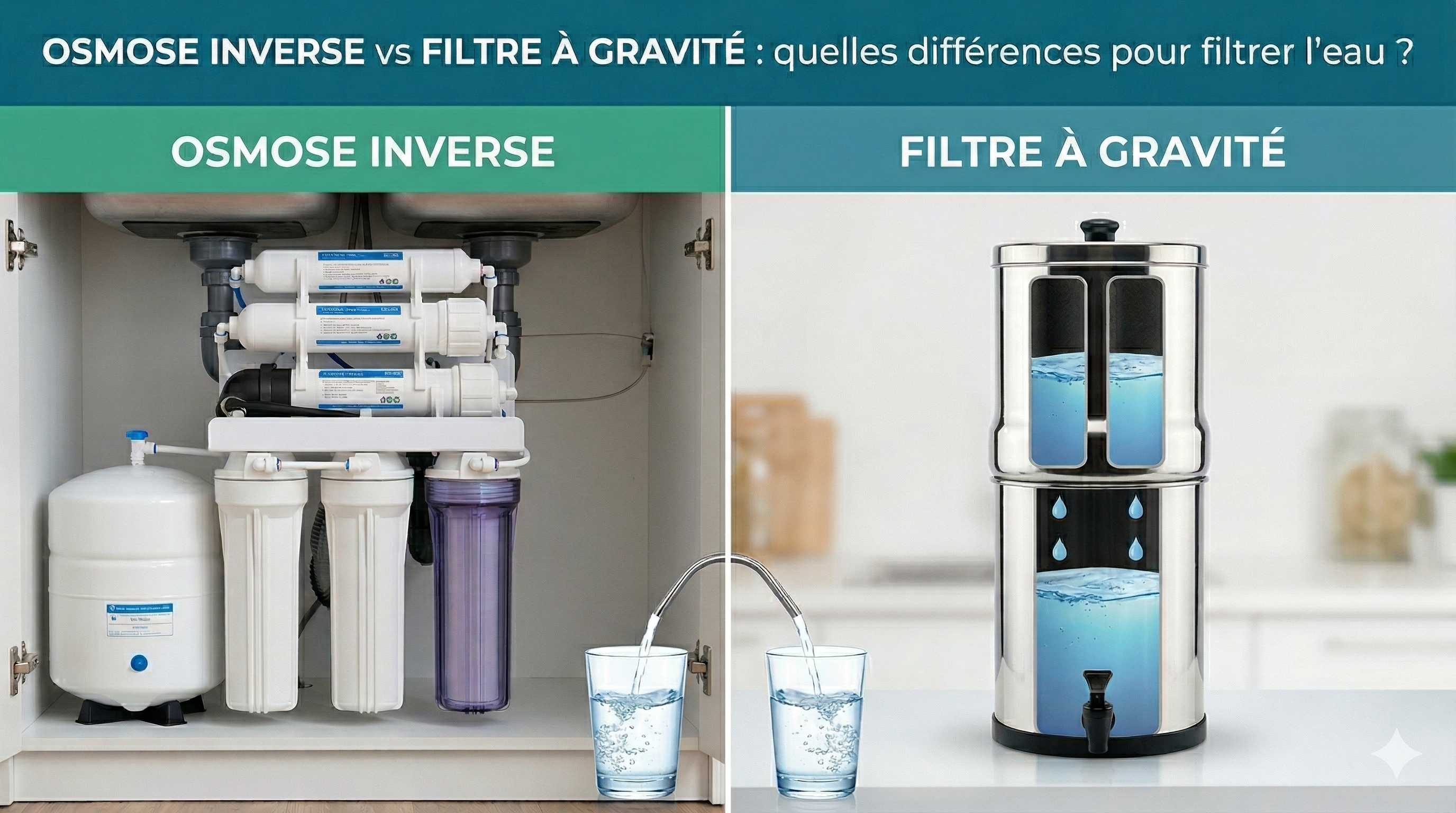
Osmose inverse ou filtre à gravité : quelles différences pour filtrer l’eau potable ? Découvrez comment fonctionnent ces deux technologies, leurs avantages et leurs limites pour réduire les contami...