



Research into nitrates and cancer is still evolving, but scientists are paying closer attention to what long-term exposure in drinking water could mean for health over time. Here’s what current res...
Panier
(0 article)
Votre panier est vide

Most of us don’t think much about why drinking water standards exist—only that they do.
But many of those limits are based on very specific health effects that have been understood for decades.
“Blue baby syndrome” is one of them.
It’s a condition that’s closely linked to nitrate exposure in drinking water, and it’s one of the main reasons nitrate levels are monitored so carefully today.
Understanding what it is—and how it relates to nitrates—can help put those limits into context.
“Blue baby syndrome” is a common name for a condition called methemoglobinemia.
It affects how oxygen is carried in the blood. When this process is disrupted, the body’s tissues don’t receive as much oxygen as they should.
In infants, this can sometimes lead to a bluish tint to the skin—particularly around the lips and fingertips—which is where the name comes from.
While the condition is rare today, it has been well documented historically, particularly in areas where drinking water contained elevated levels of nitrates.
On their own, nitrates are relatively stable compounds. But once ingested, nitrates can sometimes be converted into related compounds called nitrites in the body.
It’s these nitrites that can interfere with the blood’s ability to carry oxygen effectively.
This process is what links elevated nitrate levels in drinking water to methemoglobinemia.
It’s also why long-term nitrate exposure is understood in terms of concentration and duration, rather than presence alone. In recent years, researchers have also explored whether repeated low-level exposure over many years could contribute to certain cancers.
Infants under six months are more vulnerable to this effect for a few reasons.
Because of this, guidance around nitrate exposure is especially cautious for babies.
This is also why nitrate limits in drinking water are set with infant health in mind.
In the UK and many other countries, drinking water standards for nitrates set a maximum level of 50 milligrams per litre (mg/L).
This limit isn’t arbitrary—it’s designed to prevent the conditions under which methemoglobinemia could occur.
Public water supplies are regularly monitored to stay within this range, and in most cases, they do.
For the majority of households using regulated water systems, this means nitrate levels are kept within established safety margins.
Although public water systems are closely monitored, there are situations where nitrate levels can vary more—particularly in areas where nitrates can enter drinking water through agricultural runoff and groundwater contamination.
These include:
In these cases, nitrate levels may not be checked as frequently, which is why testing can be particularly useful.
Understanding your specific water source becomes more important in these situations, especially for households with infants.
For most people using regulated tap water, nitrate levels are managed carefully and remain within defined limits.
But “blue baby syndrome” is a reminder of why those limits exist in the first place.
It highlights how something that’s otherwise invisible in water can still matter at higher concentrations—particularly for certain groups.
If your household relies on a private water supply, or if you simply want a clearer understanding of your water quality, testing and filtration can provide that reassurance.
It’s not about expecting a problem. It’s about understanding what’s in your water and how it’s being managed.
Nitrates are a normal part of the environment, and their presence in water isn’t unusual.
But their link to methemoglobinemia, sometimes called “blue baby syndrome,” is what shapes how they’re regulated.
Understanding that connection helps make sense of why nitrate limits exist—and why they’re taken seriously, even if most people never encounter an issue.
For many households, that understanding is simply another way to feel more confident about the water they use every day.
What causes “blue baby syndrome”?
It’s caused by a condition called methemoglobinemia, where the blood’s ability to carry oxygen is reduced. This can be linked to elevated nitrate levels in drinking water, particularly for infants.
Is “blue baby syndrome” still common?
It’s now rare in countries with regulated water systems, largely because nitrate levels are monitored and controlled. Historically, it was more common in areas with untreated or untested water supplies.
Why are babies more affected by nitrates?
Infants are more sensitive because their bodies convert nitrates differently and their blood is more affected by changes in oxygen transport. They also consume more water relative to their body size.
Are nitrates dangerous for adults?
For most healthy adults, nitrate levels in regulated drinking water are considered safe. The primary concern remains with higher levels and more sensitive groups, such as infants, while researchers continue to study how repeated low-level exposure over many years may affect long-term health.
How can I check nitrate levels in my water?
You can review your local water quality report, use a home testing kit, or arrange laboratory testing—especially if you rely on a private water supply. If you'd like to better understand how nitrates get into drinking water and how testing works, this guide explains the process in more detail.
Research into nitrates and cancer is still evolving, but scientists are paying closer attention to what long-term exposure in drinking water could mean for health over time. Here’s what current res...

Boil water notices can feel unexpected, but they’re a normal part of how water quality is managed. This guide explains what they mean, why they happen, and exactly what to do at home—so you can han...
A viral video shared on X (formerly Twitter) has attracted millions of views. In the clip, a man attempts to prove that bottled mineral water is heavily contaminated by using an electrolysis device...
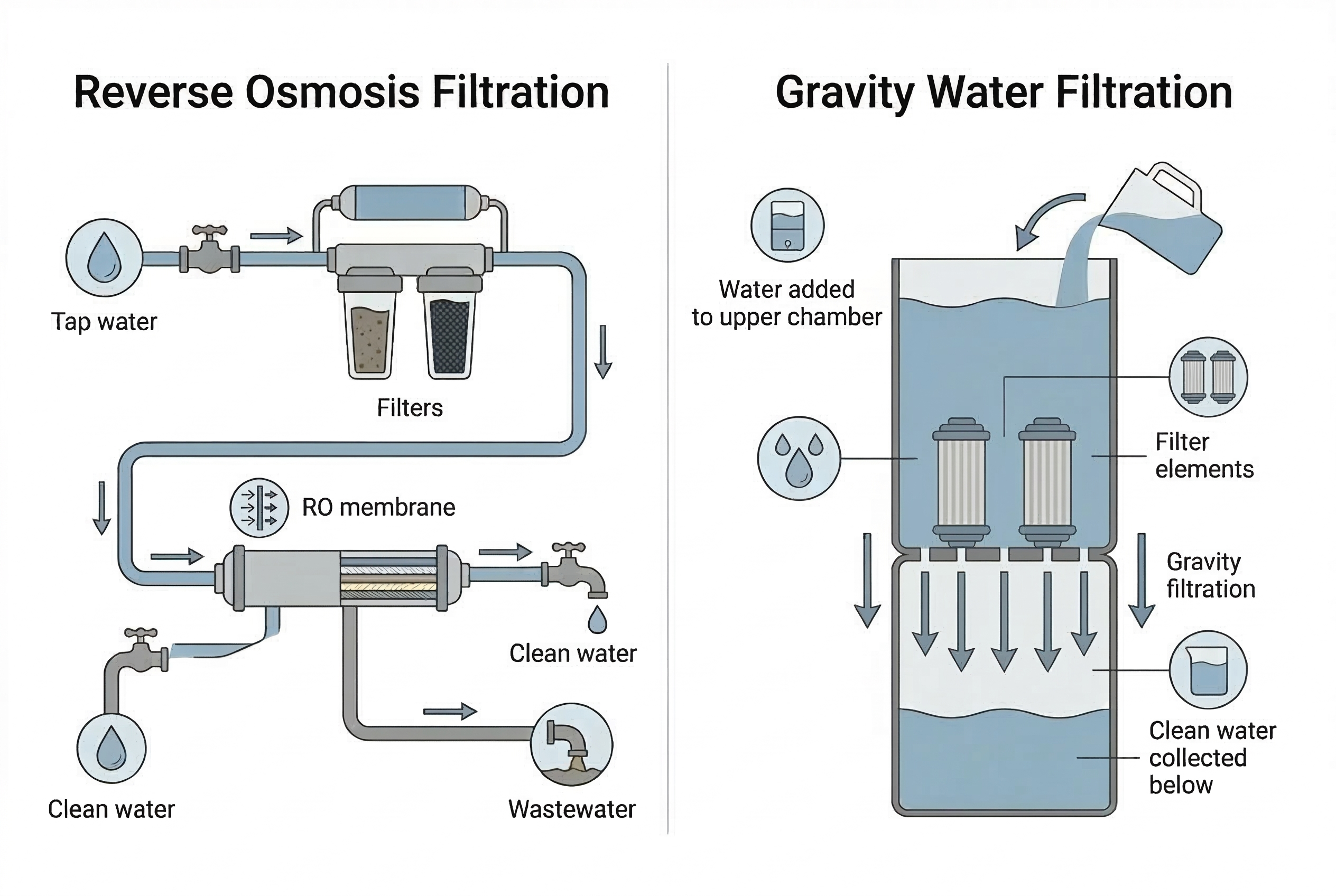
Reverse osmosis and gravity water filters both improve drinking water quality, but they work in very different ways. Learn how each system works, what contaminants they remove, and which option may...
Nestlé Waters fined over mineral water treatment practices Nestlé Waters, the bottled water division of the Swiss group Nestlé, has agreed to pay a multimillion-euro fine following investigations ...