


Nitrates et méthémoglobinémie : quels risques pour l’eau du robinet ? Comprenez le lien entre ces deux éléments et ce que cela signifie pour votre eau au quotidien.
Your Cart
(0 products)
Your cart is empty
For years, discussions about nitrates in drinking water have mainly focused on infant health and a condition called methemoglobinemia, sometimes nicknamed the blue baby syndrome.
But today, scientists are interested in broader questions: what could chronic nitrate exposure over several decades mean — not only for infants but also for adults?
In recent years, studies exploring possible links between nitrates and certain cancers have attracted growing attention. Many researchers believe that current drinking water standards may not yet fully reflect what is beginning to be understood about the potential effects of chronic exposure, even at low doses.
It is important to clarify that the issue is not only about major contamination episodes or water clearly unfit for consumption. Much of the current research focuses on the possible effects of repeated exposure to low nitrate levels over long periods.
So, where does research really stand today?
Naturally present in soils, plants, water, and many foods, nitrates are part of our daily environment. In drinking water, they most often come from agricultural runoff, fertilizers, livestock effluents, or contamination of groundwater.
In certain particularly affected regions in France, nitrates are among the most monitored contaminants in groundwater and drinking water networks.
When researchers talk about nitrate exposure, they generally do not mean a single glass of water or occasional exposure.
The question is more about what repeated exposure to low levels over decades could represent.

Researchers are studying the possibility that chronic exposure may gradually contribute to certain health risks when combined with other environmental factors and lifestyles.
This is also what makes this topic complex to study. The potential effects observed are subtle and influenced by many overlapping factors.
For many people, better understanding the quality of their water is less about fear and more about better information.
Researchers are paying increasing attention to nitrates because several studies and scientific analyses have linked chronic exposure to an increased risk of certain cancers, notably colorectal cancer.
More recent studies have also explored possible links between chronic nitrate exposure and certain cancers, including recent research on prostate cancer.
Part of the concern comes from what can happen once nitrates are present in the body. Under certain conditions, they can be converted into compounds called N-nitrosamines, some of which have been linked to cancer in laboratory research and epidemiological studies.
This does not mean that nitrates automatically cause cancer. But it explains why long-term exposure continues to receive sustained attention from researchers and public health institutions.
Research on nitrates and cancer has produced sometimes nuanced results, but there is enough evidence for the topic to remain an important public health issue.
Some observational studies have linked chronic exposure to high nitrate levels in drinking water with an increased risk of certain cancers, notably colorectal cancer. Other studies have also examined possible links with thyroid and ovarian cancers.
One of the main difficulties is that nitrate exposure almost never occurs in isolation. Diet, environment, and lifestyle can also influence the observed results.
Major scientific analyses, including those published by the London School of Hygiene & Tropical Medicine, also highlight the complexity of long-term research in this area.
Despite these uncertainties, many researchers believe that the possible effects of chronic exposure deserve even more attention.
In France, nitrate levels in drinking water are regulated and regularly monitored. The current legal limit is set at 50 mg/L.
According to the Ministry of Health, public drinking water networks are regularly monitored to ensure compliance with health standards.
Data published by EauFrance show that the vast majority of the French population receives water that meets current nitrate standards.
Historically, these standards were mainly designed to protect infants against methemoglobinemia rather than to assess the potential effects of long-term chronic exposure.
For most households supplied by the public network, nitrate levels remain within current regulatory limits. But many researchers believe that chronic exposure—even at levels compliant with standards—warrants closer attention as scientific knowledge evolves.
Private sources, wells, or individual boreholes may present more uncertainties, as nitrate levels sometimes fluctuate more and controls are often less frequent than in public networks.
In France, public drinking water networks are regularly monitored and must comply with current regulatory limits.
At the same time, many researchers believe that the potential effects of chronic exposure deserve increasing attention as research progresses.
Certain situations may justify extra vigilance regarding nitrates:
Even for households supplied by the public network, better understanding the local water quality can provide useful context for long-term exposure.
For those wanting to better understand their exposure to nitrates, the first useful step is often to learn more about the source of their water.
Not all filtration systems are designed to reduce nitrates. In cases of confirmed high levels, technologies like reverse osmosis can be more effective than standard activated carbon filtration.
Since nitrates are colorless, odorless, and tasteless, only an analysis can reliably detect them.
Scientists have not conclusively demonstrated that nitrates directly cause cancer in humans.
ANSES nevertheless emphasizes that possible links between nitrate exposure and cancer risk remain an active area of research.
At the same time, many researchers believe that a better understanding of long-term chronic exposure remains important, even when water meets current standards.
For many households, better understanding their water quality is mainly an informational and preventive daily practice.
Are nitrates in drinking water linked to cancer?
Some studies have linked chronic exposure to high nitrate levels with an increased risk of certain cancers. Researchers continue to study the exact strength of these associations.
Do nitrates directly cause cancer?
Scientists have not conclusively demonstrated that nitrates directly cause cancer in humans. The relationship remains complex and influenced by many factors.
Why are researchers studying long-term exposure?
Current research aims to better understand whether repeated exposure over several years could contribute to certain health effects.
Are current drinking water standards considered safe?
Current standards are designed to protect public health, and water networks are regularly monitored. However, some researchers believe that the effects of chronic exposure still require further study.
Does boiling water remove nitrates?
No. Boiling water does not remove nitrates and can even slightly increase their concentration.
How can I tell if my water contains nitrates?
It is possible to consult local water quality reports or have an analysis done, especially for private wells and boreholes.
For households wishing to better understand or reduce their exposure to nitrates, certain specialized filtration systems can help reduce nitrates in drinking water when properly adapted to this type of contamination.
Nitrates et méthémoglobinémie : quels risques pour l’eau du robinet ? Comprenez le lien entre ces deux éléments et ce que cela signifie pour votre eau au quotidien.

Introduction Each year, a French household spends hundreds of euros on bottled water. It is carried home from the supermarket, stored in the kitchen, reassured by the image of mountains on ...
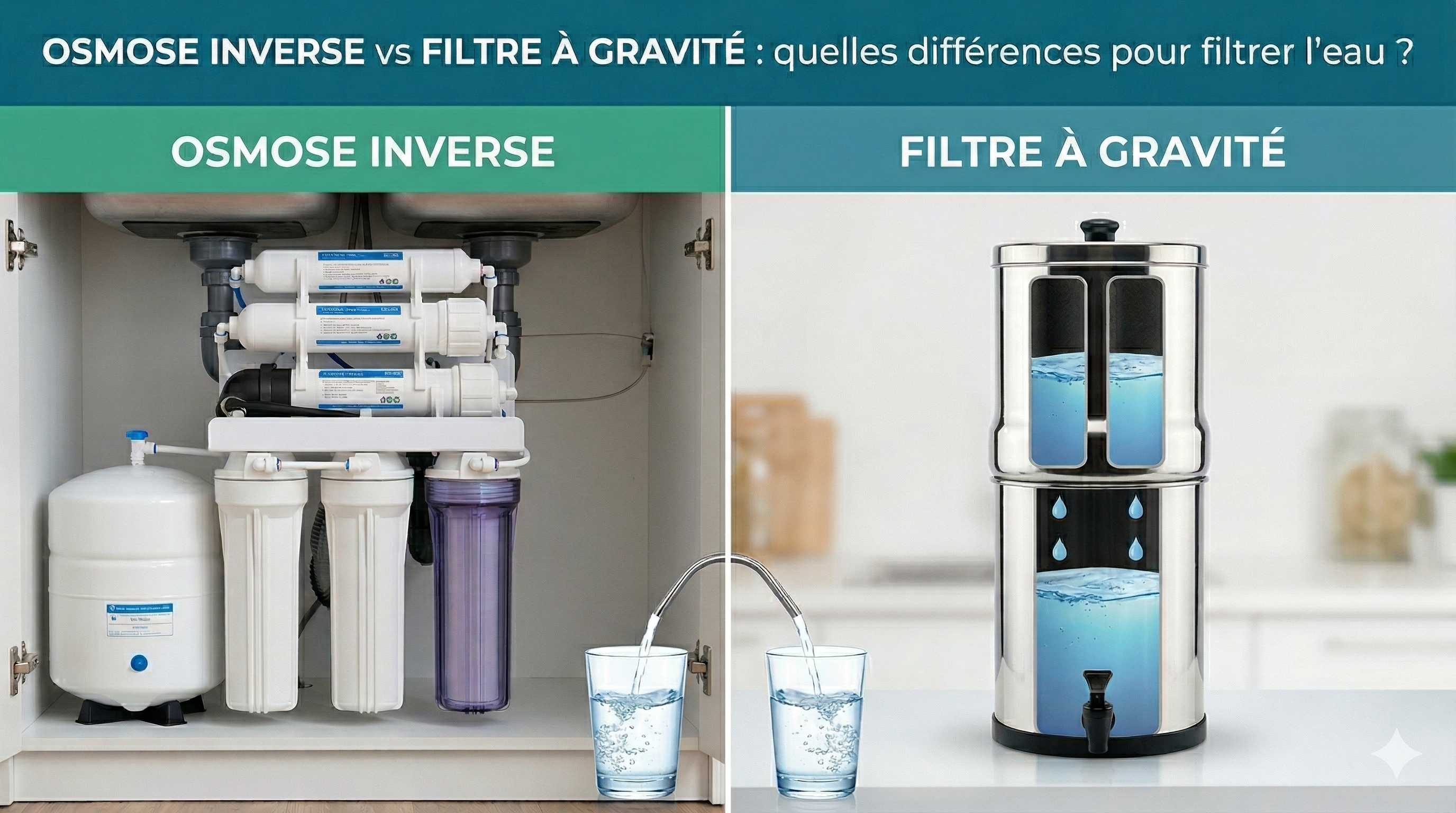
Reverse osmosis or a gravity filter: what are the differences when filtering drinking water? Discover how these two technologies work, along with their advantages and limitations for reducing conta...
Tap water is often treated to make it drinkable, but it can still contain traces of pollutants. These may include chlorine, pesticides, nitrates and pharmaceutical residues. These substances can ca...

Drinking water is an essential resource, but it can quickly become threatened during a crisis. In the wild, access to it may also be compromised. You should therefore know different ways to find, p...