



“Blue baby syndrome” is one of the key reasons nitrate levels in drinking water are regulated. Here’s how it works—and why it still matters today.
Your Cart
(0 products)
Your cart is empty

For years, conversations about nitrates in drinking water focused mostly on infant health and a condition known as methemoglobinemia, or “blue baby syndrome”.
But researchers are now asking broader questions about what long-term nitrate exposure might mean over decades—not just for infants, but for adults as well.
In recent years, studies exploring possible links between nitrates and certain cancers have received growing attention. Many researchers believe current drinking water standards may not fully reflect what is now being studied about chronic, low-level exposure over time.
Importantly, the discussion is not necessarily about sudden contamination events or obviously unsafe water. Much of the current research focuses on whether repeated exposure to relatively low nitrate levels over many years may deserve closer attention.
So where does the research actually stand today?
Nitrates are naturally occurring compounds found in soil, plants, water, and many foods we eat every day. In drinking water, they most commonly enter through agricultural runoff, fertilisers, animal waste, and groundwater contamination.
In many agricultural regions, nitrates have become one of the most closely monitored contaminants in groundwater and drinking water supplies.
When researchers discuss nitrate exposure, they are usually not talking about a single glass of water or occasional exposure.
The concern is more about what repeated low-level exposure might mean over decades.

Researchers are studying whether long-term exposure may gradually contribute to health risks when combined with other environmental and lifestyle factors over time.
This is also part of what makes nitrate research difficult to interpret. The potential effects being studied are subtle and influenced by many overlapping variables.
For many people, understanding their water source and overall exposure is less about fear and more about awareness.
Researchers are paying closer attention to nitrates because multiple studies and evidence reviews have associated long-term exposure with increased risk of certain cancers, particularly colorectal cancer.
More recent studies have also explored possible links between long-term nitrate exposure and certain cancers, including recent findings related to prostate cancer.
Part of the concern comes from what can happen after nitrates enter the body. Under certain conditions, they can be converted into compounds known as N-nitroso compounds, some of which have been linked to cancer in laboratory and epidemiological research.
That does not mean nitrates automatically cause cancer. But it does help explain why long-term exposure continues to receive scientific attention from researchers and public health institutions.
Research into nitrates and cancer has produced mixed findings, but enough evidence exists for the topic to remain an important area of public health research.
Some observational studies have associated long-term exposure to elevated nitrate levels in drinking water with increased risk of certain cancers, particularly colorectal cancer. Other studies have also explored possible links with thyroid and ovarian cancers.
Researchers are still working to better understand the strength of these associations in real-world populations.
One reason the research is difficult to interpret is that nitrate exposure rarely happens in isolation. People are exposed through food, water, occupation, and the wider environment, making it difficult to determine exactly how much risk may be linked specifically to drinking water alone.
Researchers can identify patterns and possible links without being able to prove that one thing directly causes another.
Many studies examining nitrates and cancer are observational, meaning they can identify trends across large populations without fully isolating every factor that may influence cancer risk.
Large evidence reviews, including work published through the London School of Hygiene & Tropical Medicine, have also highlighted how difficult it can be to interpret long-term nitrate exposure across different populations and lifestyles.
Still, uncertainty does not mean the research should be dismissed. Scientists often study potential risks for years before full scientific consensus emerges—especially when exposure may happen gradually over decades.
Many researchers believe current drinking water standards may not fully account for long-term exposure patterns, while others believe existing limits remain appropriately protective based on current evidence.
In the UK, nitrate levels in public drinking water are regulated and routinely monitored. The legal limit is currently set at 50 mg/L.
According to the UK Drinking Water Inspectorate, public water supplies are regularly tested to ensure nitrate levels remain within regulatory standards.
Historically, these standards were developed largely to protect against methemoglobinemia in infants rather than potential long-term cancer effects.
For most households using regulated mains water, nitrate levels remain within current legal limits. But many researchers believe long-term exposure—even within existing standards—deserves closer attention as scientific understanding continues to evolve.
Private water supplies can present additional uncertainty because nitrate levels may fluctuate more over time and are not always monitored as closely as public systems.
In the UK, public water systems are routinely monitored and required to remain within legal nitrate limits.
At the same time, many researchers believe long-term exposure patterns may deserve closer attention as research continues to evolve.
Certain situations may justify paying additional attention to nitrate levels, including:
Even for households using regulated mains water, understanding local water quality and long-term exposure patterns can still provide useful context.
For people who want to better understand nitrate exposure, the most useful first step is learning more about their water source.
That may include:
Not all water filters are designed to reduce nitrates. In situations where elevated levels are confirmed, technologies such as reverse osmosis or specialised nitrate-reduction systems may be more effective than standard carbon filtration alone.
Testing also provides important context. Since nitrates are colourless, odourless, and tasteless, there is no reliable way to detect them without analysis.
Research into nitrates and long-term health effects is still evolving.
Scientists have not conclusively proven that nitrates alone directly cause cancer in humans.
The National Cancer Institute notes that nitrate exposure and cancer risk remain an active area of research.
At the same time, enough evidence exists for researchers and public health institutions to continue studying possible links between long-term exposure and certain cancers.
Even when nitrate levels fall within current standards, many researchers believe long-term exposure deserves closer attention as scientific understanding continues to develop.
Understanding long-term exposure is less about fear and more about making informed decisions about water quality over time.
For many households, that understanding is ultimately about clarity, context, and confidence in the water they use every day.
Are nitrates in drinking water linked to cancer?
Some studies have associated long-term exposure to elevated nitrate levels with increased risk of certain cancers. Researchers are still studying how strong these associations may be and whether nitrates directly contribute to cancer development.
Do nitrates directly cause cancer?
Scientists have not conclusively proven that nitrates alone directly cause cancer in humans. The relationship is complex and influenced by many factors, including diet, lifestyle, and overall environmental exposure.
Why are scientists studying long-term nitrate exposure?
Researchers are studying whether repeated exposure to elevated nitrate levels over many years may contribute to long-term health effects, including certain cancers.
Are current drinking water standards considered safe?
Current standards are designed to protect public health and are routinely monitored in regulated water systems. However, some researchers continue debating whether existing nitrate limits fully reflect concerns around chronic, long-term exposure.
Can boiling water remove nitrates?
No. Boiling water does not remove nitrates and may slightly increase their concentration as water evaporates.
How can I test my water for nitrates?
You can review local water quality reports, use a home nitrate testing kit, or arrange laboratory testing—particularly if your household uses a private well or borehole.
“Blue baby syndrome” is one of the key reasons nitrate levels in drinking water are regulated. Here’s how it works—and why it still matters today.

Boil water notices can feel unexpected, but they’re a normal part of how water quality is managed. This guide explains what they mean, why they happen, and exactly what to do at home—so you can han...

A viral video shared on X (formerly Twitter) has attracted millions of views. In the clip, a man attempts to prove that bottled mineral water is heavily contaminated by using an electrolysis device...
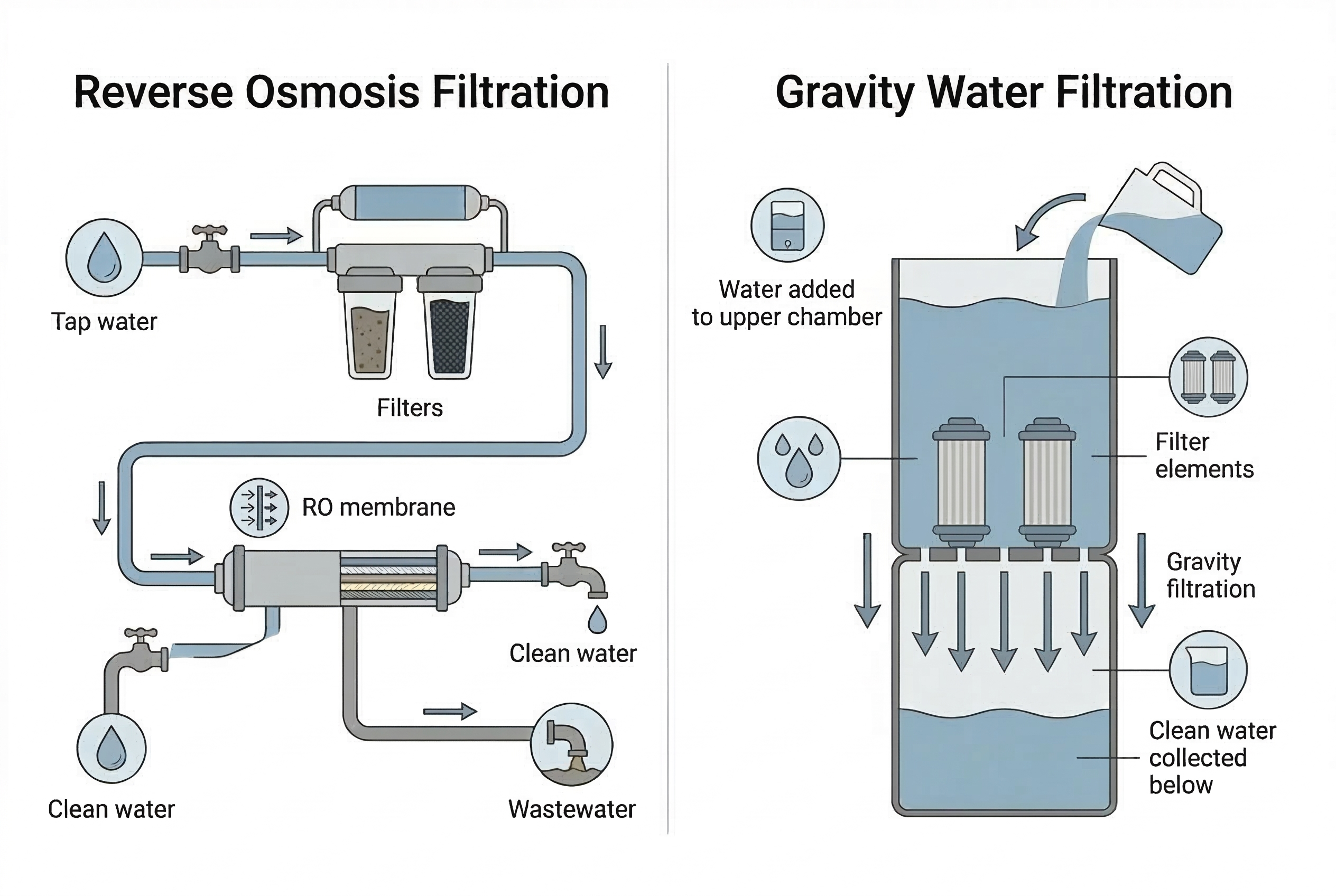
Reverse osmosis and gravity water filters both improve drinking water quality, but they work in very different ways. Learn how each system works, what contaminants they remove, and which option may...

Nestlé Waters fined over mineral water treatment practices Nestlé Waters, the bottled water division of the Swiss group Nestlé, has agreed to pay a multimillion-euro fine following investigations ...